
Green Stormwater infrastructure is a type of stormwater management that tries to protect, restore, or mimic the natural water cycle. Green stormwater infrastructure combines elements of the natural environment and traditional stormwater drainage systems to improve water quality and restore ecosystems. Green stormwater infrastructure can refer to behaviors, practices, devices, as well as being a way to design stormwater systems. Green stormwater infrastructure can be promoted through regulations, including guidelines for landscaping that take advantage of ecological benefits provided by natural processes.
Green Stormwater Infrastructure Examples:Bioretention CellsOne type of Green Stormwater Infrastructure is a bioretention cell. Bioretention cells are excavated areas designed to capture and filter stormwater runoff through specialized soil media and plants. For more technical information, visit the North Carolina Department of Environmental Quality's Minimum Design Criteria and Recommendations for bioretention cells.
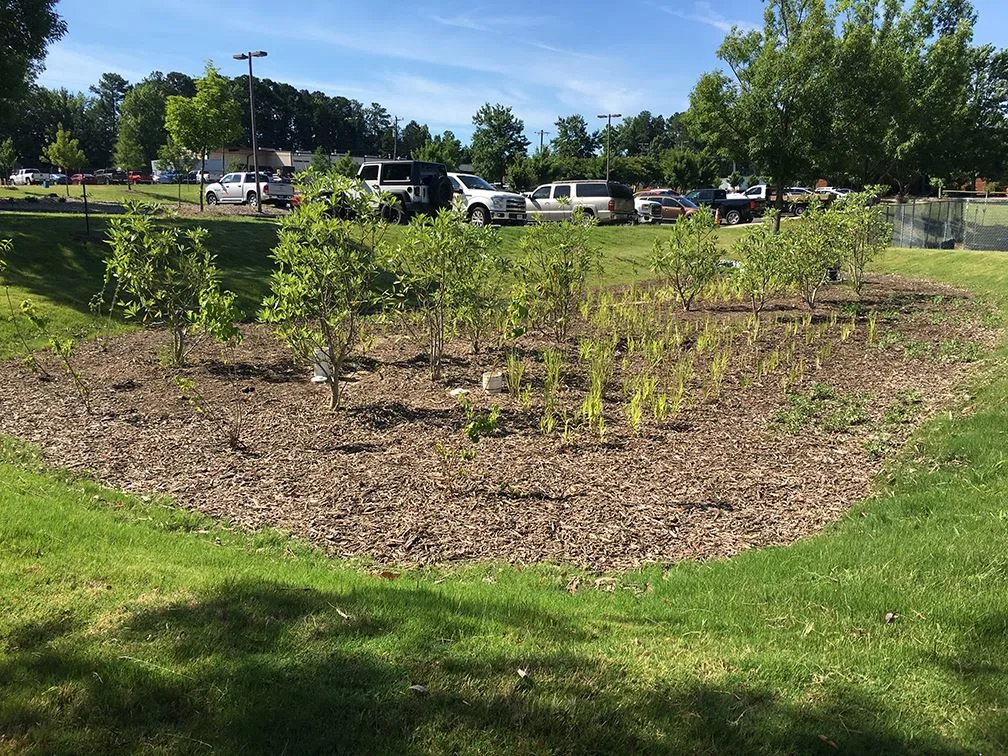
- A bioretention cell has been constructed next to the General Services Department building. The bioretention cell treats stormwater runoff from 0.85 acres of the General Services Department parking lot. This will help to improve water quality in the Ellerbe Creek watershed by reducing pollutants such as nitrogen, phosphorus, bacteria and sediment. Click here to read the August 2020 press release about the project.
A bioretention cell located next to the General Services Department parking lot
- The City of Durham partnered with Ellerbe Creek Watershed Association (ECWA) and other contributors to provide funding for the design and construction of two bioretention cells at the Pearl Mill Preserve. The bioretention cells treat stormwater runoff from 1.5 acres of residential area. Visit ECWA's website to learn more about this collaborative project.
Tree box filters are a new type of green stormwater infrastructure device that captures and treats stormwater underground. These devices are designed to be used in developed areas, such as sidewalks and street right-of-way areas. Tree box filters have similar components to bioretention cell devices.
- In December of 2018, a contractor for the Public Works Department installed two Silva Cell devices along Acadia Street near Duke Park in the Ellerbe Creek watershed. In a Silva Cell, stormwater is retained underground while trees and special filter media remove pollutants. These modular devices are well-suited for urban areas with limited space for larger, traditional stormwater control measures. See the North Carolina Department of Environmental Quality's Minimum Design Criteria and Recommendations for Silva Cells for more information. The Public Works Department worked with staff from General Services and Parks and Recreation to find a suitable location and appropriate trees for these devices. North Carolina State University (NCSU) was awarded a grant from the Clean Water Management Trust Fund to study how well these devices work in Durham's clay soils. In addition to providing the tree with a source of water and nutrients these devices allow tree roots with room to grow. The City worked closely with NCSU and the manufacturer (DeepRoot) to design a system that will fit into the park setting. Researchers from NCSU's Stormwater Engineering Group will monitor and study the devices to understand how they can be used elsewhere in the city.